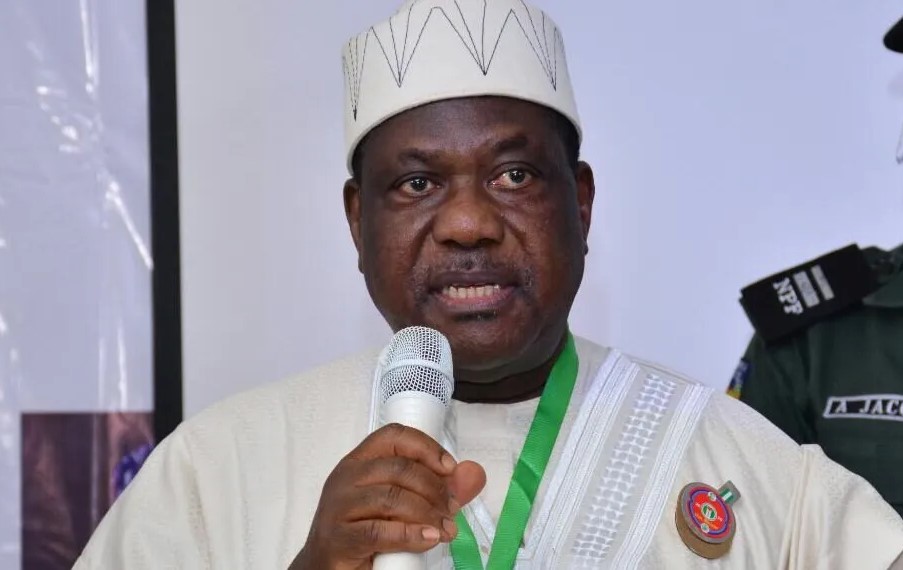
In Nigeria’s noisy political arena, leadership is often measured by visibility: by how loudly one speaks, how dramatically one acts, and how frequently one dominates the headlines. Nigerians call it “capacity.” Yet there is another kind of leadership, less theatrical but often more enduring: the politics of steadiness. George Akume belongs to that category.
Having served Nigeria for more than 25 years, George Akume occupies a special place in Nigeria’s political firmament. The man has served in various government appointments, both in elected positions and in the civil service. From a civil service career to chairing local governments, he rose to Director-General (Permanent Secretary) of Establishment Services in Benue State. This is an important qualification that many Nigerian politicians do not have.
When Nigeria turned to democracy in 1999, he was the third Governor of Benue State and the first in the Fourth Republic. Akume’s government did not chase headlines; instead, it focused on the fundamentals of governance and laid the groundwork for subsequent governments to deliver the dividends of democracy.
In line with his Benue Advance Plan, he laid the framework for nearly every sector of the state’s economy. These include restoring stability to the state’s civil service through regular and timely staff appointments and salary payments, reviving the state’s health sector by constructing the Benue State University Teaching Hospital, College of Health Sciences, and General Hospitals in all LGAs as well as upgrading the Federal Medical Centre in Apir and the School of Nursing and Midwifery in Makurdi. He improved the state’s housing by constructing the Owner-Occupier Housing Estate for state civil servants and the Judges’ Quarters, constructing roads in the state, notably the Benue Links, by acquiring transport infrastructure such as the Marco Polo and Toyota HiAce buses, improving agricultural production through fertilizer subsidies and the completion of the Benue Fertilizer Blending Plant, and providing bursaries/scholarships to outstanding students in various local and foreign institutions of higher learning. Akume opened the Greater Makurdi Water Works to address the state's water supply challenges. He made roads, drainage, and erosion control projects in the urban centres famous, as well as the provision of transformers and motorised boreholes by BERDA to rural communities to ease the burden of lack of electricity and potable water.
When his eight-year term as governor ended, Akume transitioned to the Nigerian Senate, where he served three terms as the Senator representing Benue North-West from 2007 to 2019. He continued to serve with the same tenacity and humility despite the challenges. His tenure was notable for his ability to manoeuvre through the political minefields of Senate procedures and practices, particularly as Minority Leader. The position of Senate Minority Leader demands patience and a willingness to compromise to reach consensus rather than confrontation. Akume demonstrated a propensity for collegiality and conciliation throughout his tenure, both in the Senate and in other leadership posts he held.
President Muhammadu Buhari nominated Akume as Minister of Special Duties and Intergovernmental Affairs in 2019, and he served in that capacity until 2023. He therefore has had the opportunity, as a Minister, to handle matters that require delicate handling and demand the art of “diplomatic handling,” as experts say.
In 2023, President Bola Ahmed Tinubu appointed him Secretary to the Government of the Federation (SGF). The SGF role is not just another role. It is an administrative, coordinating, and procedural role. It requires discipline and discretion more than rhetoric. And it is central to how federal governance actually works. In this office, Akume’s earlier bureaucratic grounding resurfaced.
His vast experience in the civil service, local government, state government, the federal government, and the Senate is unparalleled. For this reason, among others, the Leadership Institute has decided to honour him with the “Lifetime Achievement in Leadership Award,” which seeks to recognise leaders who have served their country throughout their careers.
However, one must ask whether a leader so long in service to Nigeria can truly be said to have made any significant contribution to the country. A lifetime achievement award is often criticised as nothing more than a prize for politicians who have served in office for an unusually long time. We should not overlook the fact that long tenure in office does not always result in effective leadership.
Instead, we must ask what this tremendous achievement says about leadership in general and Nigerian leadership in particular.
First and foremost, this lengthy service recognises and celebrates individuals who have demonstrated a strong commitment to institutional development both in the public and private sectors. This is critical to achieving effective governance in Nigeria, which has been hampered by weak institutional governance. Second, it acknowledges that leadership is a function of temperament rather than rhetoric in Nigeria's current contentious political environment. Akume has consistently shown a moderate approach to governance throughout his public life. He is not the type of leader to employ populism or drama to achieve his goals. Akume has earned the respect of Nigerians across the political spectrum.
Another aspect of this extended service is linked to the theme of visionary Leadership. Nigeria requires visionary leaders who do not just seek to rule for the sake of ruling but who have a vision for the country. Leadership should build rather than destroy. Akume has demonstrated visionary leadership throughout his tenure in public office. He has effected some of the most needed reforms in agriculture, health, education, and infrastructure development.
The Leadership Institute’s decision to honour George Akume with the “Lifetime Achievement in Leadership Award,” therefore, sends out signals to Nigerian political leaders about the kind of leadership the country needs. By choosing him, they have essentially said that the time for “governing for the sake of governance” is over. The new Nigeria needs leaders committed to institutional development across all sectors of the economy. It implies that the time has come for more visionary leadership that envisions a developed and self-sustaining Nigeria.
The main lesson we take from this lifetime achievement award is that leadership is a calling, not a profession. We do not have to look to the far corners of the world for leadership role models, looking for individuals who fit the image of “dynamic leadership.” It is high time we rethink our understanding of leadership so that it is not always associated with confrontation, especially in Nigeria’s current highly polarised political climate. There is no doubt that his most endearing quality has been his ability to serve with humility and integrity while earning the respect and trust of successive governments.
George Akume’s leadership philosophy and sheer ability to deliver in various leadership positions have already left an indelible mark on Nigeria’s political turf. It is this record that has earned him this well-deserved honour. Whether in the civil service, the Senate, as a Governor, or as the Minister of Special Duties, he has fulfilled his mandates with competence and diligence.
Bem Max Nomor is a policy and leadership researcher at the Leadership Institute (Nigeria)