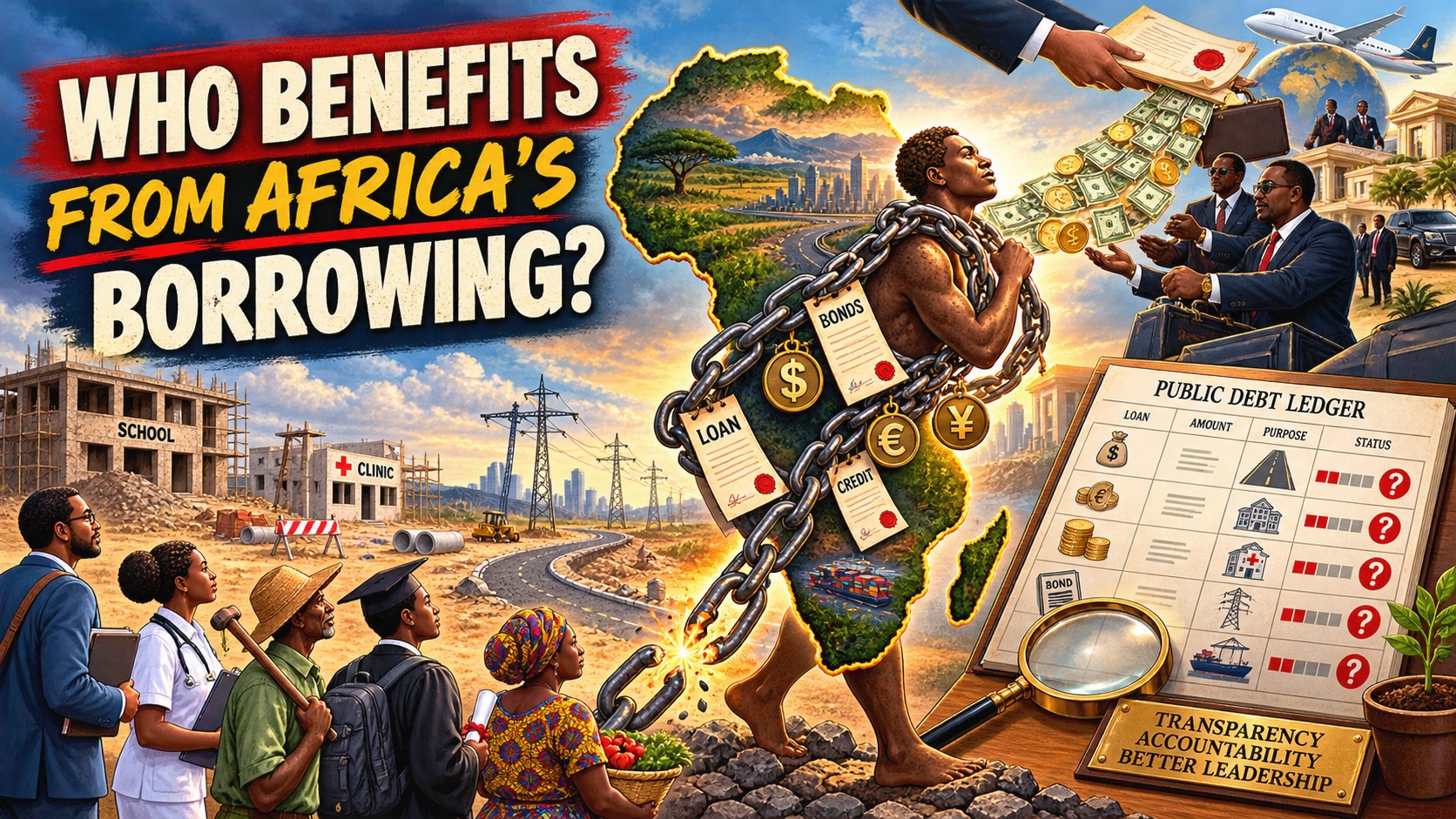
Africa’s debt crisis is often presented as a contest between an unfair global financial system and a continent that has borrowed beyond its means. Both explanations contain truth, but neither is complete. The deeper question is not simply how much African countries owe. It is what the borrowed money accomplished, who benefited from it and who will bear the cost of repayment.
According to the UN Economic Commission for Africa, the region’s average public-debt-to-GDP ratio stood at roughly 63 per cent in 2025. Interest payments consumed nearly 15 per cent of government revenue. And about 40 per cent of African countries were in debt distress or at high risk of default. Funds that could have financed hospitals, schools, the electricity grid and the rest have gone to creditors.
That is not necessarily the whole story. It is also a contest of credibility.
Debt is not inherently irresponsible; indeed, authorities must sometimes take on liabilities to finance railways, power plants, ports, water infrastructure and other projects that deliver long-lasting benefits to the economy. And a government that stubbornly avoids taking on any liabilities will not only keep its balance sheet pristine, but also leave its people without the very tools of development.
Debt becomes irresponsible when governments borrow to fund consumption, poorly planned schemes, patronage networks or sweetheart deals not open to public scrutiny. It is unjust when the proceeds go to the political and business elite and ordinary citizens are left to foot the bill years later, with no offsets in public goods.
Ghana and Zambia are living examples of countries whose development trajectories were derailed by borrowing sprees. Zambia became Africa’s first pandemic-era sovereign defaulter in 2020 and began extensive restructuring with official and private creditors. Ghana suspended external debt payments in 2022 and local debt repayments in 2023. The two countries are now in extended fiscal negotiations to turn their economies around.
The lesson from their experience is not that Africa should refrain from borrowing altogether. Rather, it concerns the opportunity cost of today’s liabilities: a new government could inherit an economy already saddled with substantial payments because of its predecessors' mismanagement.
Africa is right to push back against the unfair financial architecture around sovereign lending. The region’s nations typically pay far more for the privilege of debt than similar economies elsewhere in the world. Credit-rating practices often impose punitive interest rates on Africa’s sovereign borrowers. Restructuring mechanisms remain opaque, prolonging the pain for distressed nations for years after defaults. In short, the continent needs more predictable, equitable mechanisms for sharing the burden of resolving unsustainable liabilities.
The African Union’s decision in February 2026 to pursue a Common African Position on Debt is therefore a good start. Africa cannot hold its creditors to higher standards if its governments do not adopt more honesty when selling their borrowing to the public. Indeed, all major public loans must be subject to publication of their basic terms and repayment terms. The public must always know the size, rate, and maturity of the liabilities, while the government should be required to justify which projects it intends to fund and the revenue streams for repaying the principal and interest due. Parliaments must subject proposed borrowing to intense scrutiny well before any capitalisation date arrives. Independent auditors must verify that governments use the money borrowed for their declared purposes, and public officials must be punished if they fail to deliver the value for money promised. Loans through state-owned entities and public-private partnerships must also be published in their entirety. Nations must always examine such arrangements to ensure that liabilities initially kept off budget do not later be shoved into the budget when the venture goes bad.
Nor can Africa’s creditors be completely absolved. A lender that knows it is funding an opaque, corrupt, or economically irrational scheme in Africa should not expect poor countries to socialise its losses. Responsible lending on both sides of the transaction is needed.
The African Union should therefore rethink its approach to sovereign defaults beyond negotiations to improve the terms of future financing. It should set out continental debt–transparency rules and create a public registry of sovereign borrowing. The AU should give its new African Debt Management Institute the mandate to evaluate risks well before crises erupt, and individual member states should be scored not just on the size of liabilities but on quality of disclosure too.
Africa must improve tax collection, cut illicit financial flows and invest more heavily in existing public assets. Borrowing should not be seen as a permanent substitute for building functioning tax systems, productive economies and prudent public spending.
Debt is always a claim against the future. All government loans represent an obligation to citizens who voted for the party in power – or did not – and against children who may not yet be born but who will have to pay back the money their leaders borrowed in their names. Such financial power must never be wielded irresponsibly or held secret from the people.
Africa deserves a more equitable financial system, but it also needs leaders who do not abuse the borrowing power in office to enrich themselves and their allies or damage their successors. Africa must always measure responsibility by how much money governments keep back for the public good after they spend the borrowed money.
Bem Max Nomor is a policy and leadership researcher at the Leadership Institute (Nigeria)